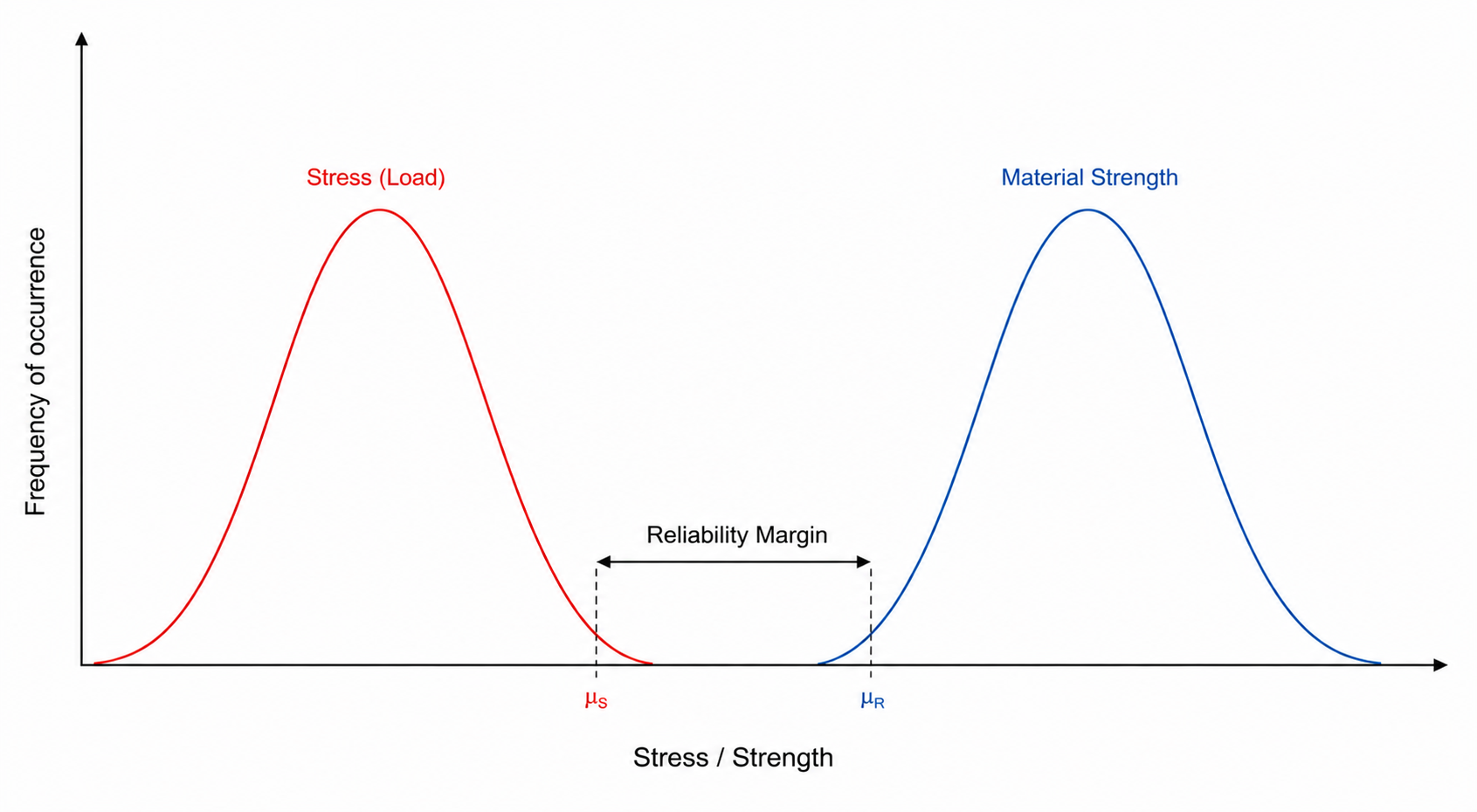
Reliability is defined by the balance between load and strength.
Problem
Components are often designed based on ideal assumptions, while real operating conditions introduce varying loads that can reduce reliability.
Approach
I developed a physics-based model to quantify thermal loads and relate them to material strength using stress–strength principles.
Outcome
The approach enables estimation of reliability margins and supports design decisions under realistic operating conditions.

What I did
• Modeled thermal loads based on system operation
• Linked load conditions to material strength
• Applied stress–strength concepts to assess reliability margins
• Supported component-level design decisions
• Optimsied effiecny on sysltem-level
• Linked load conditions to material strength
• Applied stress–strength concepts to assess reliability margins
• Supported component-level design decisions
• Optimsied effiecny on sysltem-level
What was difficult
• Translating real operating behavior into model inputs
• Handling variability in operating conditions
• Balancing model simplicity and physical accuracy
• Handling variability in operating conditions
• Balancing model simplicity and physical accuracy
What I learned
• Reliability should be addressed at the design stage
• Physical understanding is essential for meaningful modeling
• Combining system knowledge with modeling improves decisions
• Physical understanding is essential for meaningful modeling
• Combining system knowledge with modeling improves decisions